Young Living Cookbook Our Fields to Your Family
About Russians consider their chief goal to be to start a family and heighten good children. Source: ITAR-TASS
Most Russians assert that they strive towards a salubrious, close-knit family unit and marriage for life. However, sociologists point to research indicating that in reality, Russian federation's denizens behaves otherwise, engaging in adultery, divorce, and homosexuality.
In early June, the Russian regime presented a report entitled "Conception of Land Family unit Policy for the Menstruation up to 2025". The document pointed to the crisis in the Russian family in the late 1990s and early 2000s, citing the effects of depression fertility rates, the prevalence of divorce, and the weakness of family ties. The government's new policy seeks to remedy this situation.
At first glance, ordinary Russians appear to empathise the function and meaning of the family unit in the aforementioned way that politicians do. The newly published policy concept describes traditional family unit values as the government understands them: marriage for the purpose of bearing and raising children on the basis of mutual respect amongst all family unit members.
Russia'south Public Opinion Research Center (VTSIOM) conducted a survey in March 2012, the results of which showed that 93 percent of Russians consider their primary goal to be to start a family unit and enhance practiced children.
The Zircon Research Grouping carried out a similar study in July and August 2013, finding that almost one-half of Russians (43 percent) view the ideal family unit as requiring formal lifelong marriage: a total family with a mother, father, and children, ruled past dear, mutual understanding, and respect for elders.
However, the reality is far from the ideal: Only eleven percent of respondents believe that their ain families live up to these parameters.
New family values
Leonty Byzov, sociologist and caput of VTSIOM's Analytical Department, is certain that people but pay lip service to the regime'due south family policy, which has no influence on their own behavior.
"In reality, Russians practice precisely that which they strongly condemn: They divorce, cheat on their spouses, and engage in homosexual behavior," the sociologist said.
Starting in the 1990s, the family unit values of Russian youth underwent desperate changes during Russia'due south sexual and feminist revolution, said Tatyana Gurko, physician of social sciences and section head of family sociology at the Russian Academy of Sciences' Institute of Folklore, in an interview with Gazeta.ru. Those same processes of feminism and sexual revolution began to take hold in the U.s.a. and Europe 30 years earlier, in the 1960s.
"During the past decade, the family values of young people take been starting to exclude an expectation of lifelong marriage. The new generation, including those with children of their own, has loyalties that lie with successive marriages, children out of marriage, cohabitation with unmarried partners, and even infidelity," Gurko said.
According to her, today's Russian youth does not believe that "every woman should become a mother" and likewise welcomes equality in relations between partners.
Families in large and small cities
Russian federation has a loftier number of marriages, divorces, and remarriages, in dissimilarity with European countries, where both marriages and divorces are few, and Muslim countries, which take many marriages but few divorces.
In contempo years, however, the charge per unit of early marriage (from 18-24 years of historic period) among Russians has halved, Gurko told Gazeta.ru. Co-ordinate to Gurko, in 1980, 62 percent of young men and 68 percentage of young women married early, figures which fell to a corresponding 29 percentage and 44 percent in 2011. About young people now delay marriage until the ages of 25-34.
Gurko noted that values first began to change in large cities, where immature people ofttimes ally but remain childless. In Russian federation'southward regions, early marriages and child rearing remain popular in small-scale cities with low standards of living.
Having children out of union is too a phenomenon with an ethnic and regional character; it is more than mutual in Siberia and the Urals. According to census data, children born out of wedlock account for 68 percent of births in the Commonwealth of Tuva (along the border with Mongolia) and 56 per centum of births in the Koryak Autonomous Area (in the Kamchatka Territory in the Far East).
Infantile generation
Co-ordinate to Gurko, the new generation of youth in large cities adopts infantile modes of behavior, continuing to live with their parents even after graduating from university.
"As a result, they practice not develop a feeling of responsibility for their partner and their own children. Families in large Russian cities more and more resort to individual services for childcare, elderberry care, and housework," the expert said.
Byzov added that Russian society today is fractured and atomized, with the majority of people having few social ties.
"The circumvolve of loved ones has narrowed to exclude all but parents and children. Aunts, uncles, grandparents, and great-grandparents are often not included. The real social values of Russians are at odds with their espoused values. In place of family unit values, we frequently see values of personal growth, success, career, and 1's own welfare," the skilful explained.
This article contains material from Gazeta.ru.
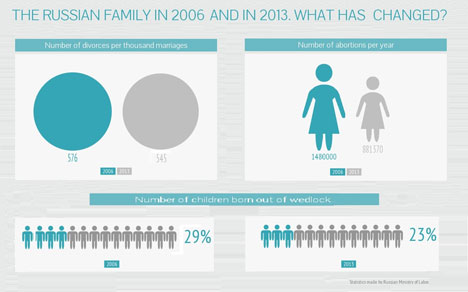
Click to enlarge the infographics
Read more: Surrogacy in Russia: What are the options for childless couples?
All rights reserved by Rossiyskaya Gazeta.
Get the week's best stories straight to your inbox
Source: https://www.rbth.com/society/2014/07/25/the_contemporary_russian_family_traditional_in_word_slippery_in_deed_38531.html
0 Response to "Young Living Cookbook Our Fields to Your Family"
Post a Comment